
Walking Through Florence: Stories From a Weekend With Locals
It’s the mid of March, and it’s been nearly six months since we both moved to Munich. Ever since our move in cold and grey German winters, we’ve been desperately waiting for the sun to “spring” up. But are only baffled to see snow and rain forecasts week in and week out. Who knew that misery was finally about to end – for a weekend trip to Florence is just around the corner!
Ah, Italy! The only time the two of us have travelled to Italy together was in 2016 for the Venice Architecture Biennale; and guess what, as work-colleagues! It was, in fact, our first trip abroad and one that had tied us together forever. Seven years on, and we return to Italy, now having tied the ‘official’ knot.
Table of Contents
ToggleImagine a pair of woman’s lips, puckering for a kiss. That is the city of Florence, narrow at the edges, swelling at the centre, with the Arno flowing through between, parting the two lips, the upper and the lower. The city is an enchantress. When it kisses you, you are lost, whether you be commoner or king.
Salman Rushdie, The Enchantress of Florence.
Benvenuto! Touchdown at Firenze
Firenze – where do we even start?! It’s a city full of history, love, art, architecture, food, and warmth – all that one imagines Tuscany to be!
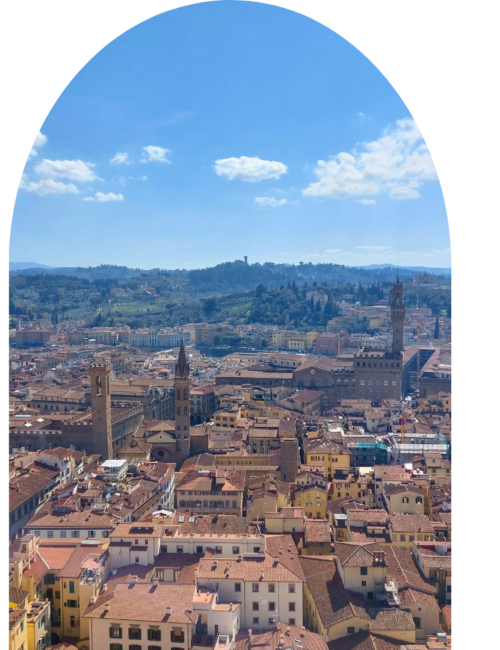
Florence, the capital city of Tuscany and the birthplace of Renaissance, rose to wealth and power from 14th through 16th century, mostly through trade and banking. But apart from these commercial operations, it also became a powerhouse of artists, architects, engineers, painters, sculptors, and many more creatives. Whether you’re standing underneath Michelangelo’s “David” or climbing Brunelleschi’s “dome”, every street turn and every corner will feel like a living museum still stuck in the bygone-era.
We’re in Florence to meet our dear Brazilian friends, Leticia and Bernardo, who’ve called this gorgeous city home for nearly two years. Exploring Florence through their lens is going to offer us a different way into the city – not just for its celebrated art and architecture, but also for its culture, traditions, and everyday life that continues to shape it.
Walk alongside us to know the many secrets of Firenze!
Andiamo ragazzi! Stepping outdoor as locals
Arguably one of the best cities to walk your way around, Florence has mesmerised us at every turn. Our dear friend and host, Bernardo, is highly enthusiastic to take us on a guided tour, and we must admit he’s given us a deep dive into art history. In hindsight, it’s a no-brainer how passionate and curious he is towards Florence’s rich heritage, for where he lives now is right across the former home of Mr. MICHELANGELO. Hell yeah!
Living in the limits of the old city has its own charm. The moment we stepped out, we could already feel the transition, of reality to myth, for the spell was all around. From the facade elements, the arches spanning across the streets, the sheer size of paving stones, the ancient gutter systems or the in-built street-side seats attached to the plinths – each seemed untouched by time. It’s also a welcome change to see a bit of chaos when it comes to street traffic. It felt more like home (India), and rather contrasting to the German orderliness.
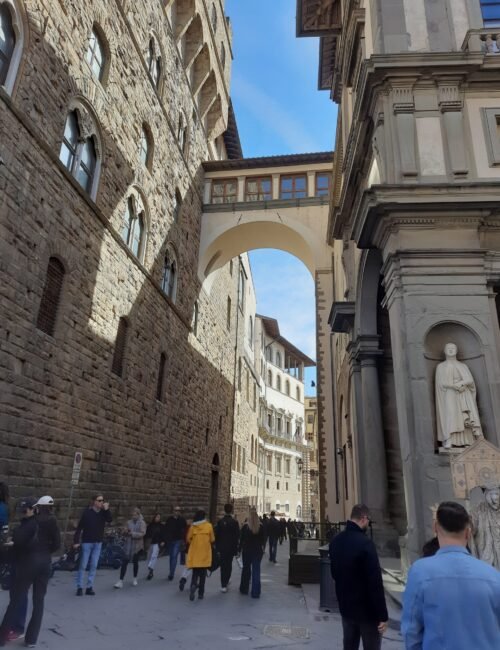
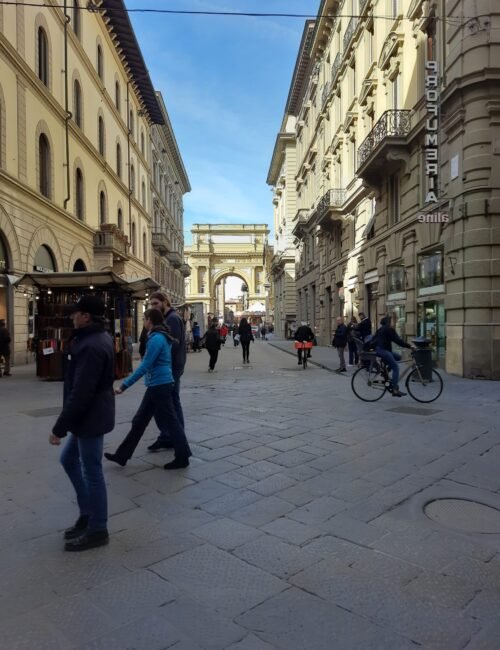
First things first: We take off towards the glory of Florence, the Piazza (plaza in italian) del Duomo, where the Cathedral of Santa Maria del Fiore sits.
As the street opens up to the plaza, and the dome slowly comes into our field of vision we notice our stride slacken and our heads tilt up. We’d studied and seen a thousand photos and text about this structure back in our architecture schools, but to physically stand beneath the world’s largest masonry dome took a while to gulp down.
“We are climbing the duomo tomorrow!” said Forum excitedly.
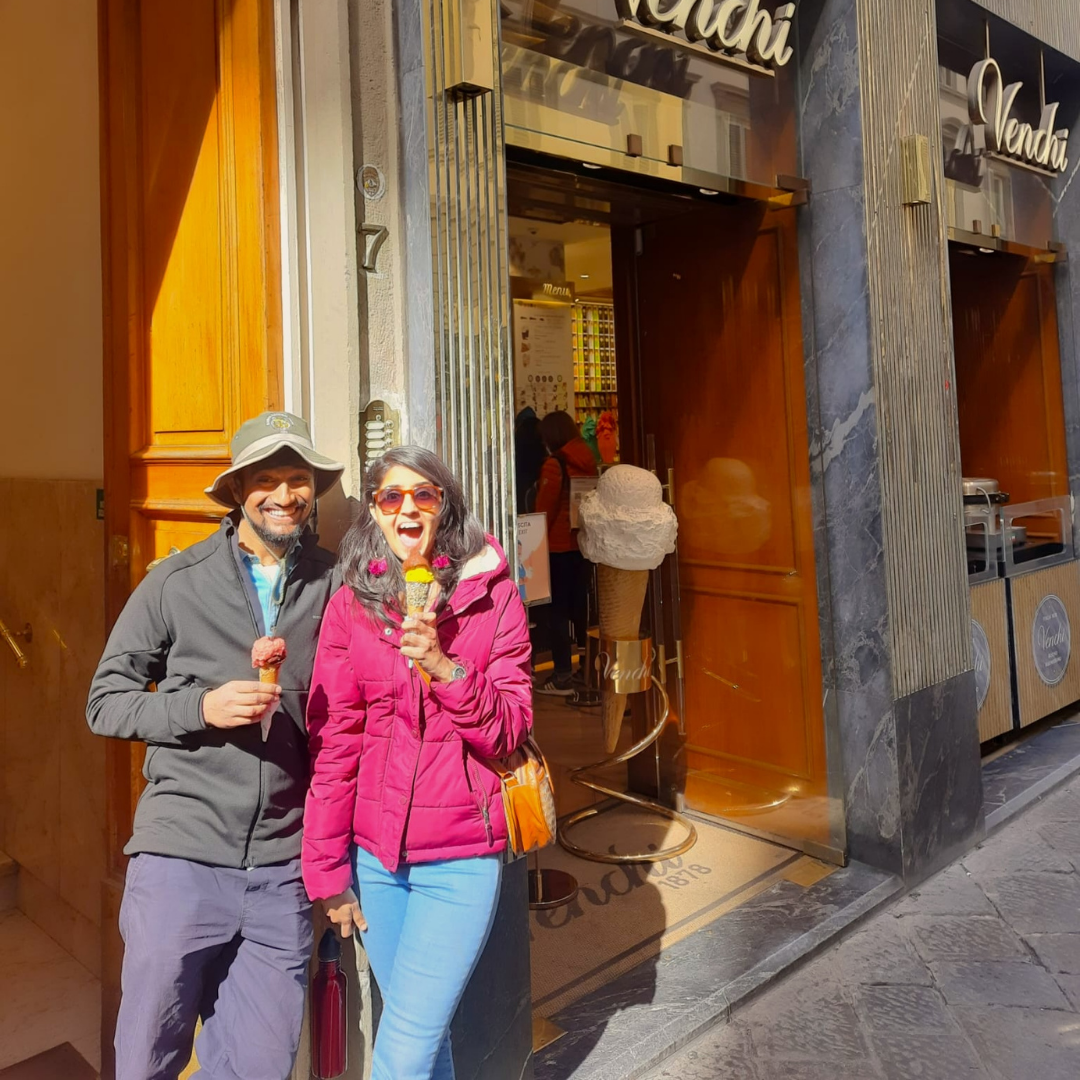
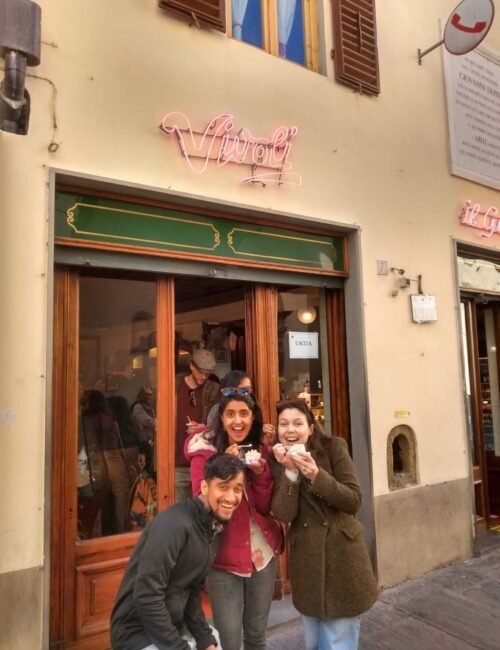
Continuing on our “acclimatization” stroll, our eyes (unsurprisingly) fell on a chocolate waterfall within a gelato store. Before we knew it, all of us were grabbing our first vegan gelatos! Not a bad way to begin the day, is it? Although the gelatos at Venchi were great, we learn that they aren’t local favourites. The authentic flavours are at Vivoli and Dei Neri – and the best one to try is Buontalenti, the mother of Gelatos. As Bernardo puts it, “At least one Gelato a day is an absolute must when you are in Firenze!”
Renaissance – Rinascimento or “Re-birth”
With our sweet teeth attended to, we both become avid listeners, promptly following the footsteps of our guide, and stopping at main points of interest. Soon we realize that Florence is probably the only city in the world, where you accidentally end up at the doorsteps of legends. Perhaps, it is no coincidence that a movement as big as the Renaissance began in this little town of great-minds.
The master-poet Dante Alighieri’s residence is between the Church of San Martino and Piazza die Donati. As we walk past his home (now a museum), we learn that his work “The Divine Comedy”- which he had then chosen to write in the local Tuscan dialect – had paved the way for the modern Italian language as we know it.
Travelling, indeed, is a great teacher!
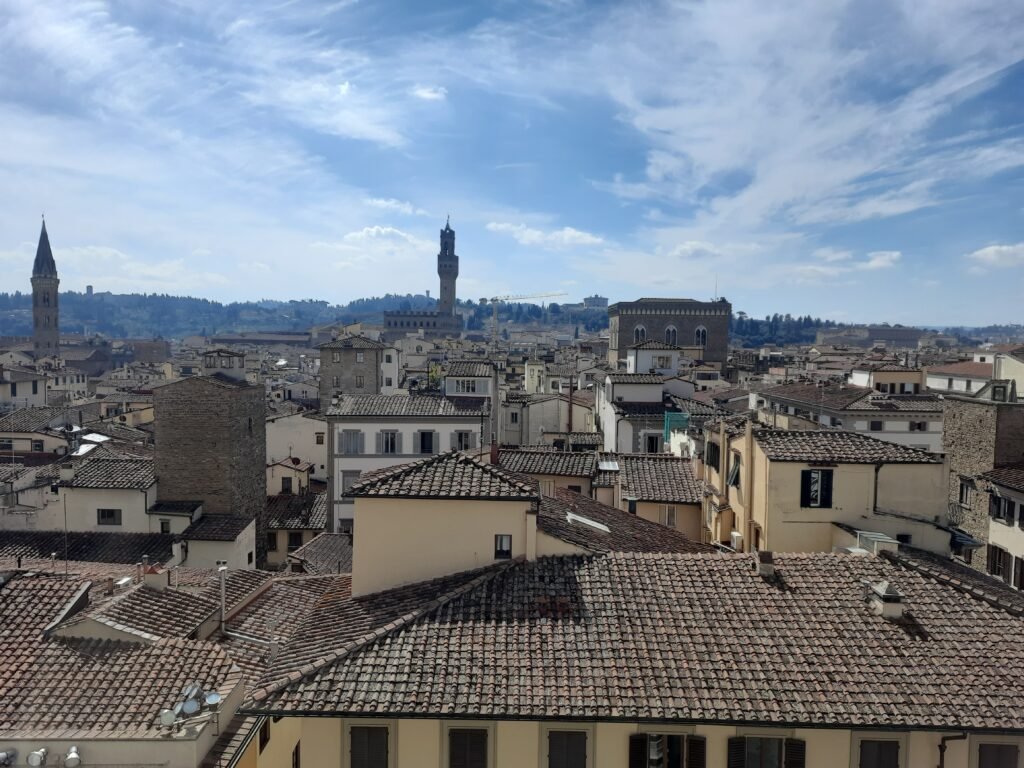
Approaching the iconic Arnolfo tower, Shiva remarks “Ah, the Medicis!” Having watched the TV series Da Vinci’s Demons, it is easy to recognize this tower. Bernardo grins, “Most of my knowledge also comes from TV shows, my friend.”
The Palazzo Vecchio to which the tower belongs, was originally the city hall of the Florentine republic, later on becoming home to the Medicis, a wealthy banking family who’d eventually become the ruling monarchs. Their reign had lasted for three centuries! Over this period, they had commissioned the work of most top-notch artists of the time, leaving their mark all over Florence.
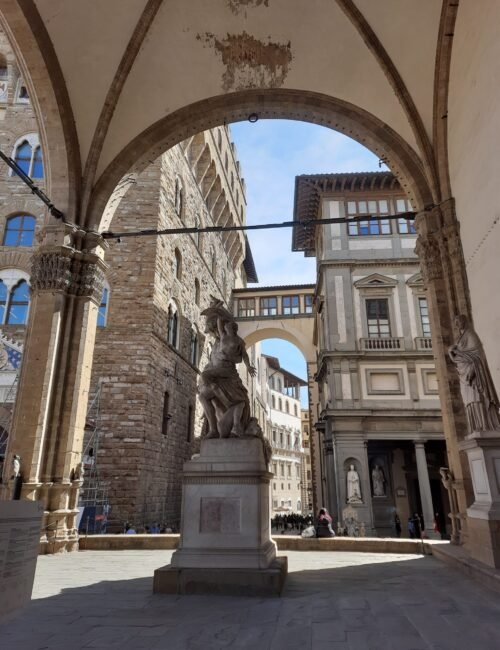
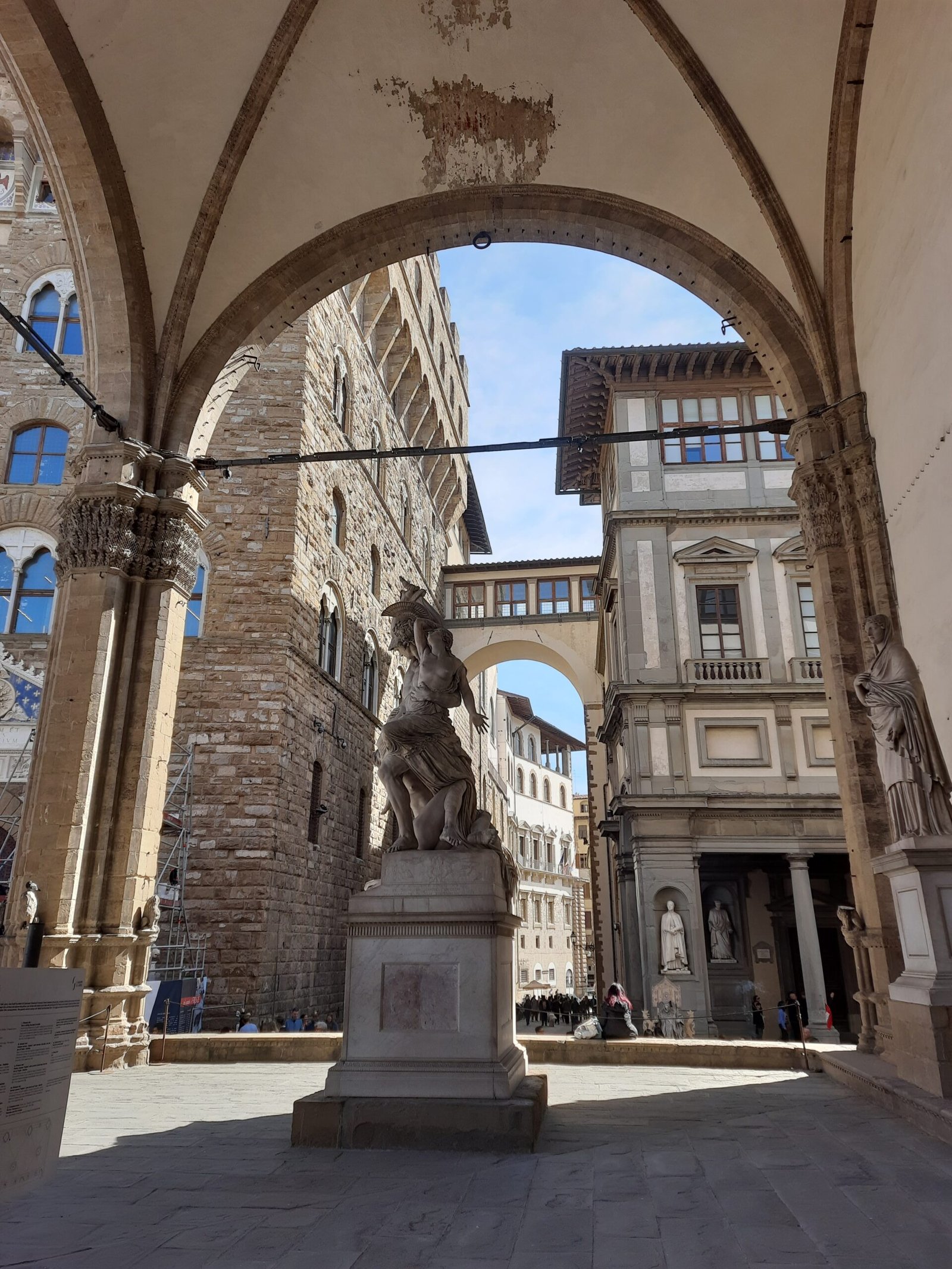
Florence is an open air museum, there’s something to see each way you turn. When you study the finer details of the sculptors at the open-arched gallery Loggia dei Lanzi, you’ll understand how the study of human anatomy had taken a new leap back then.
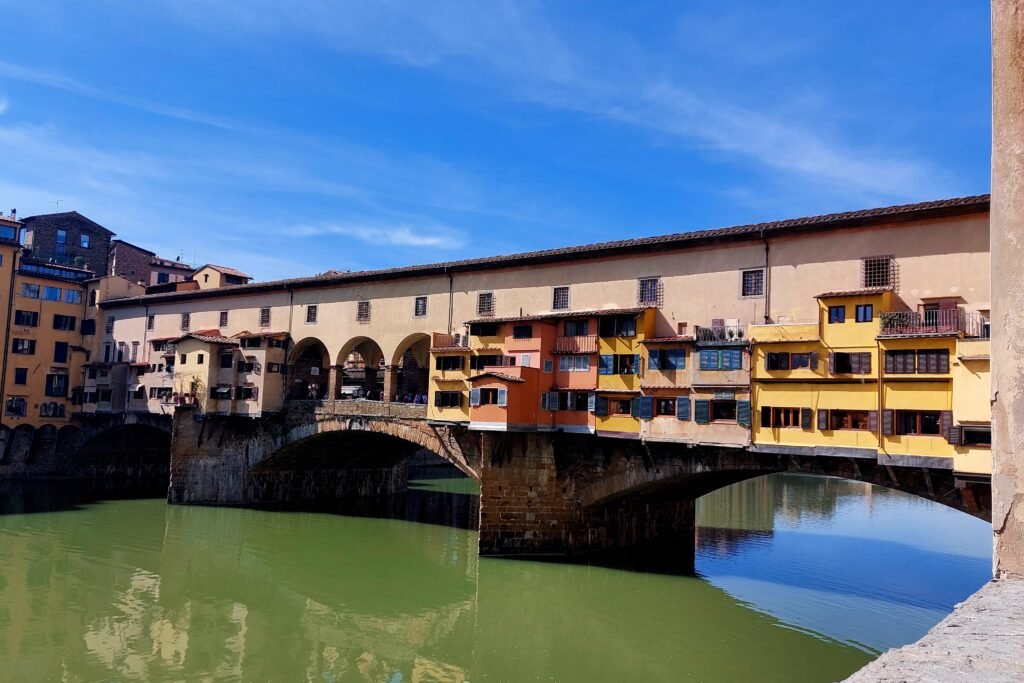
The Ponte Vecchio, that bridge which is covered with the shops of jewelers and goldsmiths, is a most enchanting feature in the scene… that precious glimpse of sky, and water, and rich buildings, shining so quietly among the huddled roofs and gables on the bridge, is exquisite.
Charles Dickens
The 16th-century Skywalk
Back in the 16th century, when the affluent Medicis moved to a bigger palace across the river Arno, they cooked up an ingenious plan for their daily commute to work. A “sky-walk!” Too rich to walk among their citizens, they chose to connect their new home, now a kilometer away, with an overhead, private-access passage. Imagine walking right above the city, and that too, unnoticed!
Named the Vasari Corridor, this covered, aerial route is one-of-a-kind. Built in a record time of just five months, it begins by forming bridges that connect the top floors of multi-storey buildings. It then runs along the river Arno, supported by a huge arcade, before crossing the river via a footbridge — climbing right over the shops that line the bridge.
No words can quite describe its uniqueness. The fact that this once private passage is now opening up to the public is, for sure, exciting!
The footbridge itself, namely Ponte Vecchio, is one of the classics in town. Hitler is known to have left this bridge alone when he retreats, while mindlessly bombing every other bridge across the Arno. If you pass by here in daylight, the mildly green river and all the earthy tones of the bridge come together to cast a surrealistically warm canvas — almost like a highly processed photograph!
A slow Italian afternoon embracing Dolce Far Niente
Time seems to pass slowly when you are in Florence. At noon, we sit down at an outdoor table at Ristorante Borgo Antico, next to a brightly sunlit square. The sun on our cheeks and the relaxed atmosphere loosens up our bodies.
An Italian meal comprises of seven distinct courses: Aperitivo, Antipasti, Primo, Secondo, Contorno, Dolce, Caffè and Digestive. As vegans, we are suggested Contorni, which are usually platters of grilled vegetables. Meals here, however, begin with an Aperitivo — typically a glass of wine served with some olives and fresh bread. Another unique Italian tradition is that the bread is usually unsalted. Along with it, olive oil is provided by default. We watch closely as Bernardo pours a generous amount of oil onto his plate and sprinkles salt and pepper over it. This becomes the dip for the unsalted bread. Bravo!
With a satisfying meal under our belts, it is now time for a Passeggiata — a leisurely walk. With all the time in the world, Italians love taking a walk (a long one!) after a meal. It is common even among working professionals to reserve two to three hours around midday for this form of ‘appreciation for life’.
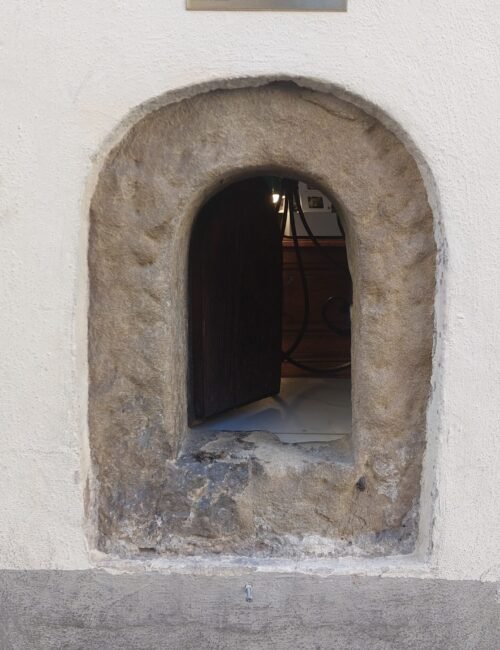
Wine windows and wine barrels
As we wander about at ease, picking up a gelato each, a miniature window at a gelateria catches our eye. The name above it reads: “Wine Window.”
Bernardo, our ever-knowledgeable friend and guide, fills us in. “You will find many of these in Florence. The aristocrats back then usually had an excess of wine in their cellars. As an act of goodwill, they would hand over some of it to passers-by who knocked on the window shutter. What’s even nicer is that these sprung back into use during Covid times, functioning as no-contact shopping counters. Customers would place money in the window in return for their wine, panini, etc.”
There isn’t a thing our expert guide doesn’t seem to know about, we think, as we end our walk with a customary coffee, just as he suggests.
Florence has a long history of selling and consuming wines locally rather than importing the bottles. Tuscany’s terroir (limestone- and clay-rich soil and warm sunny weather) is ideal for growing grapes that ripe slowly and create an evenly balanced taste. In fact, winemaking in Tuscany dates back to the ancient Etruscans. During the Middle Ages and the Renaissance, Medici promoted local wines, and even created one of the world’s first regulations on wine production. So if you’re a wine lover, Firenze should be your next stop!
A climb-athon morning!
It is our second day in Florence, and we can barely contain our excitement to climb the cathedral’s dome and stand on top of Florence!
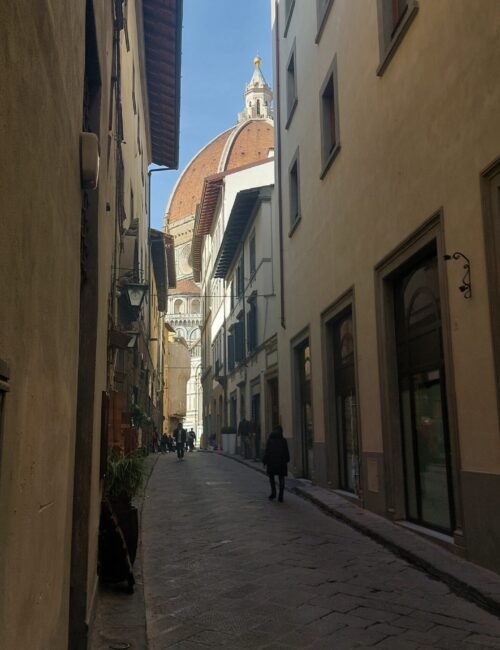
Finding our way to the Duomo isn’t hard at all — all you gotta do is look up and walk towards the towering red-coloured dome. In fact, catching glimpses of it from the surrounding streets is, by itself, a wholesome experience.
We arrive an hour before our scheduled visit to the Duomo and decide to first climb Giotto’s Bell Tower, the square-in-plan tower only a few metres shorter than the top of the Duomo, is a major symbol of Florence and a masterpiece of 14th-century Gothic architecture. There are about 414 steps to reach the rooftop, but what’s fascinating about these stairs is the way they’re positioned.
For the first two storeys, the stairs wrap around the four walls, concealed within the thickness of the structure. For the remaining three floors, however, the tower opens up into loggias — open galleries — and the stairs are squeezed into a single corner pier, spiralling upwards in a remarkably narrow passage. Only one person can climb at a time in some of these tight spaces. While it is thrilling, it also demands patience as we occasionally have to pause and let others pass.
As we near the topmost terrace, the bell suddenly begins to toll, reverberating through the entire structure and sending echoes racing through the stairwell. For a moment, we simply stand there and take it all in. And then we step onto the terrace.
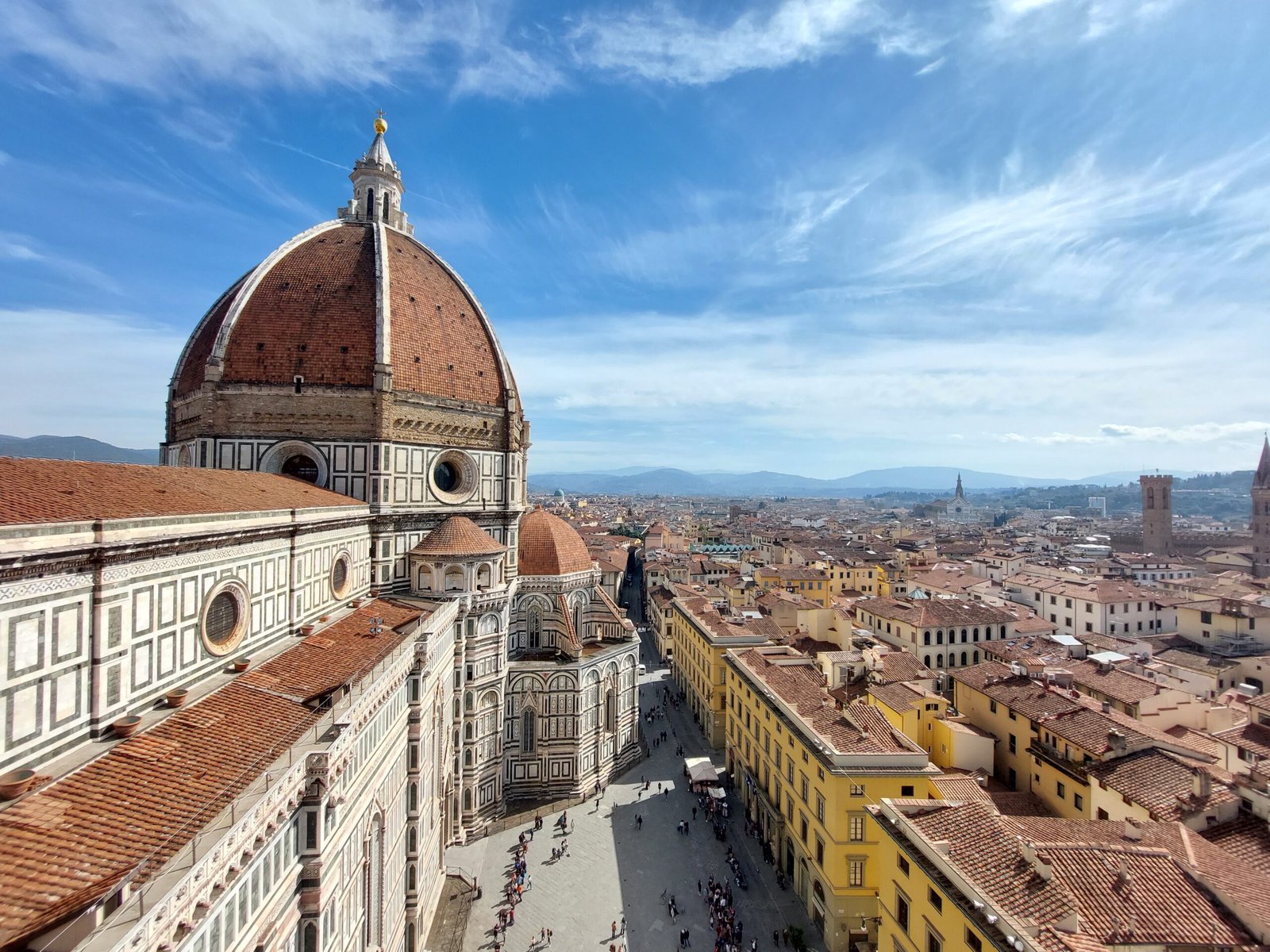
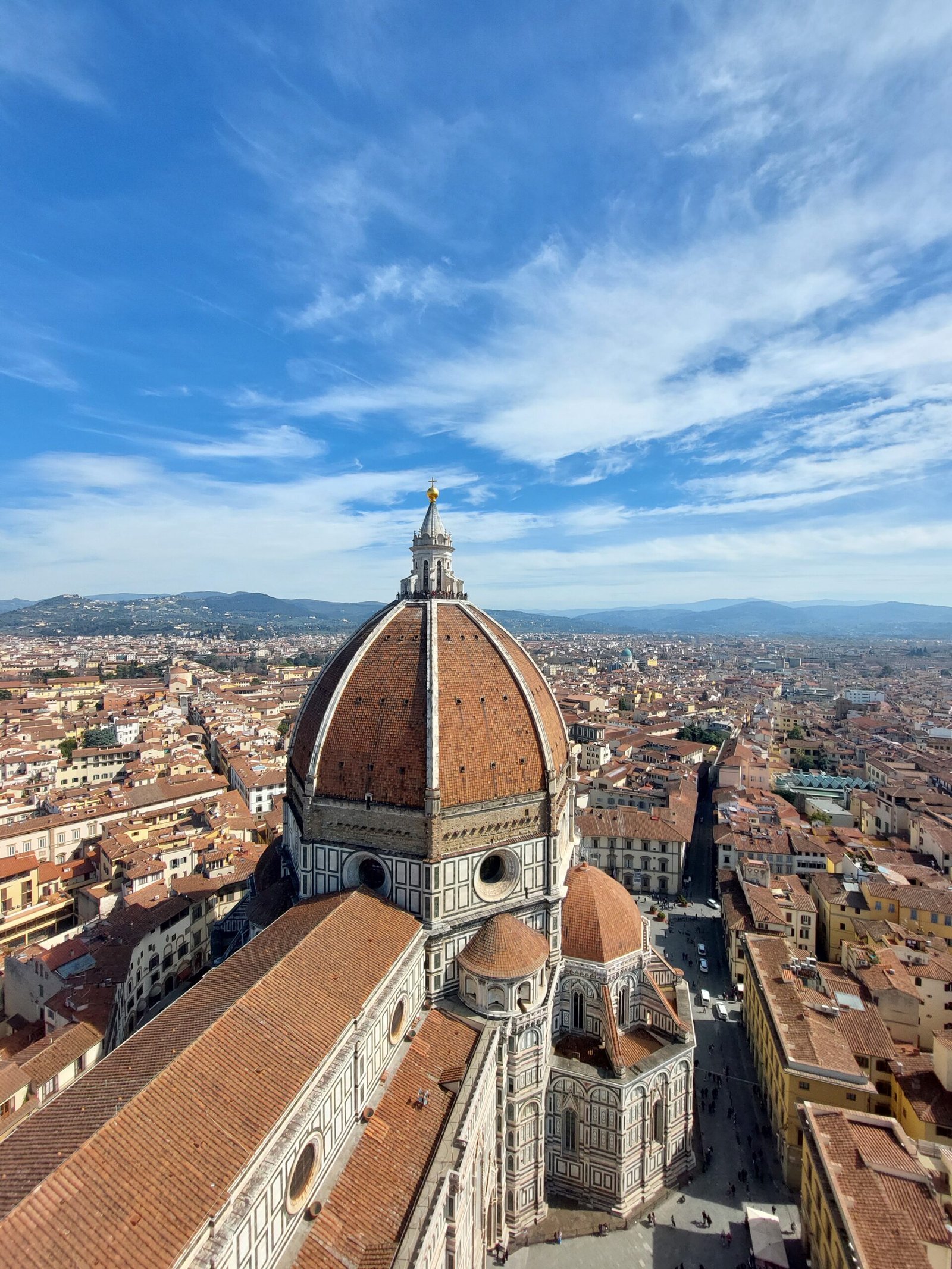
Looking at the red, clay-tiled dome from up here is a gorgeous sight indeed. We admire it for a while — until we realize that we still have one more, even more arduous climb ahead of us!
Brunelleschi’s Eggs-periment
Back down in the heat of the square, we scan around for a quick drink. Being in Italy is a boon — the piazza is bustling with colourful carts selling fresh-fruit juices and smoothies. A few sips of cold berry smoothie later, our reserves are renewed for the next big climb.
The greatest masonry dome of its time has quite a story to tell. Construction of the cathedral had begun in 1293, but the dome remained unbuilt for more than a century. The challenge was quite daunting: how does one span such a large, irregular octagon without the help of traditional wooden formwork?
In 1418, a competition wass announced to find a solution. Enter Filippo Brunelleschi, a goldsmith by training with no formal background in architecture. Legend has it that he’d arrived at the competition with nothing but an egg. He challenged the judges to make it stand upright on the table. When nobody succeeded, he simply broke the egg and placed one half on the table.
The point is simple but revolutionary: sometimes, the solution lies in looking at the problem differently.
Brunelleschi won the competition and went on to design a double-shell dome — lighter and strong enough to support itself without the massive external buttressing that had traditionally been needed. He also introduced new methods of bricklaying, lifting and construction, even designing much of the machinery required to bring his vision to life.
Over the next 16 years, his vision took shape above Florence.
A true marker of the Renaissance rises before us — the product of one man’s extraordinary ability to imagine what nobody else could yet see.
Our climb to the cupola terrace begins much like the one up Giotto’s Bell Tower, with narrow stairs winding through the walls. But once we reach one of the octagonal galleries inside the dome, the experience changes completely.
From here, we enter the narrow passage between the dome’s two shells and begin ascending along its steeply curved surface. The route, originally designed to allow workers and materials to move during construction, is hardly an easy one to traverse. It is, however, extraordinarily unique.
Circular openings in the outer shell let in shafts of natural light as we climb, giving us fleeting glimpses of the immense structure around us. With every step, it feels as though we are moving through the very construction story we have just been reading about.
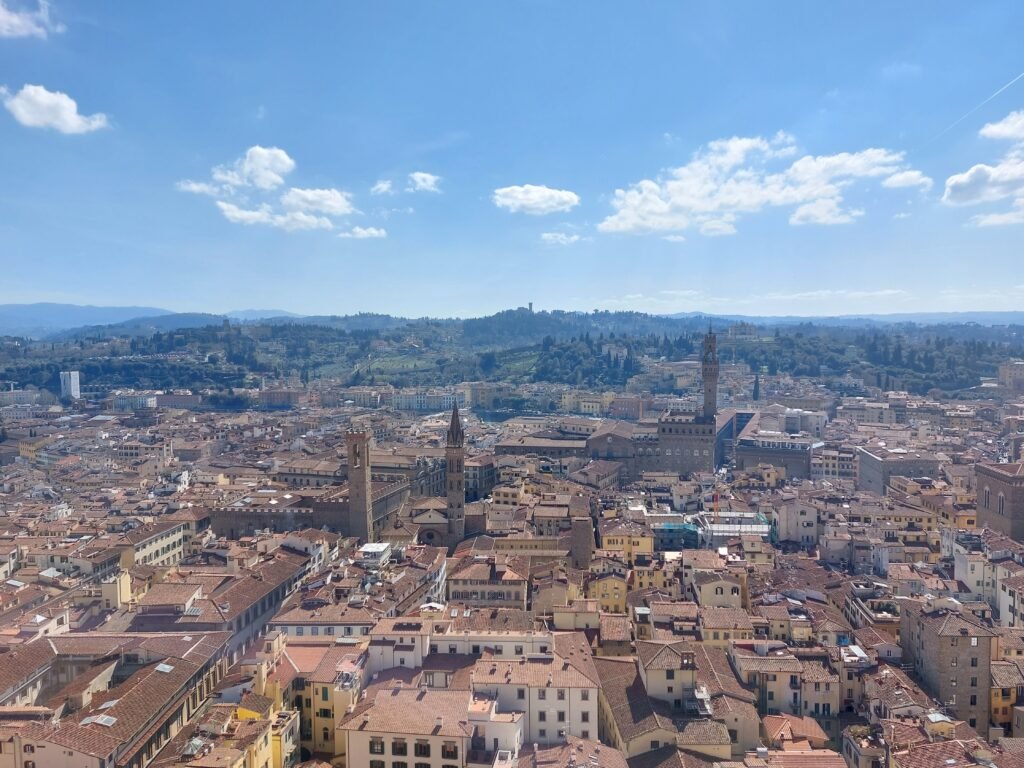
The strenuous climb finally pays off as we emerge from within the brick mass and step onto the open terrace.
And then, there it is.
Florence, spread out beneath us.
Panini-Vini-Celebrazioni
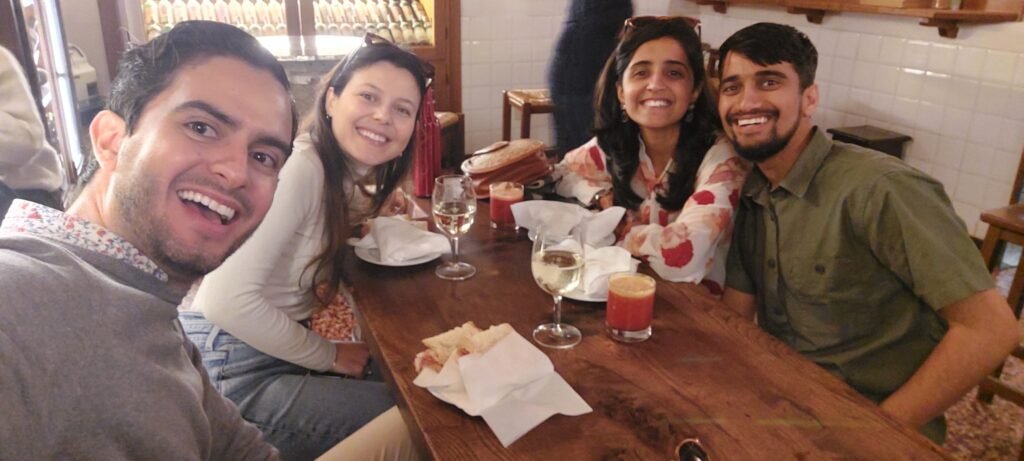
After summiting Florence’s two tallest landmarks, it is a joy to be greeted once again by our chicly dressed Brazilian hosts, Bernardo and Leticia. They have just the right proposal for the moment: a visit to Orizi Mariano, a café nearby.
Stepping down from the street into this cosy little snack bar, tucked inside what feels like a repurposed old wine cellar with vaulted ceilings, we feel as though we have entered a hidden world.
Run by an old and particularly charming couple, the place is ambience at its best. Age-old wine bottles line the walls, while old wine barrels are repurposed as dining tables. The place is popular for its freshly prepared Panini (sandwiches) and Schiacciata (Tuscan flatbread), and the owners make the experience even more delightful by helping us choose the right combination of bread and fillings from the menu.
After all that climbing, a good panini, some wine and a little celebration seem just about perfect!
A Special Way to Light Up Your Night
We spent the entire afternoon at the Opera del Duomo Museum, trying to wrap our heads around hundreds of artworks and relics while gathering yet more insights into the genius of Brunelleschi. With far too much information to juggle, we finally call it a day.
Leticia then suggests a short hike up a nearby hill — something she usually reserves for her weekends. Atop the hill, just across the Arno, sits Piazzale Michelangelo, offering one of the most panoramic views of Florence.
Although it is within walking distance, we are surprised by how suddenly the landscape shifts as we approach the hill. Bernardo points out that we have already crossed the old city wall and are now in the outer territory. The switch from cobblestones to asphalt beneath our feet is the clearest indicator.
As we climb up from the valley, the city gives way to graceful olive groves, elegant cypresses and towering umbrella pines. It is also amusing to see that half of Florence seems to be heading uphill with us, many carrying their aperitivo— wine and snacks tucked into tote bags.
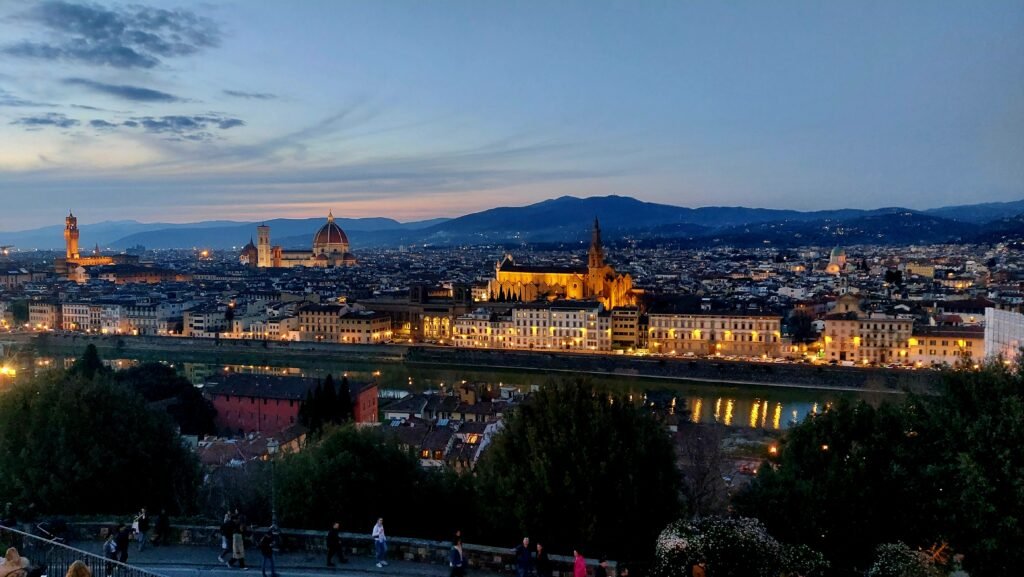
We scan the area for the perfect spot for the four of us. And then, it is all about waiting for the big moment — Florence in full bloom.
With the cool breeze brushing our faces and the aperitivo keeping us warm, we slowly let our gazes drift across the picturesque skyline. Just when we think we have missed the sunset, the city begins to light up. The last to come alive is the lantern atop the Duomo’s Cupola.
From up here, the Basilica of Santa Croce also stands in full might, its brick façade glowing warmly against the darkening sky. It is, without a doubt, the perfect moment for a toast.
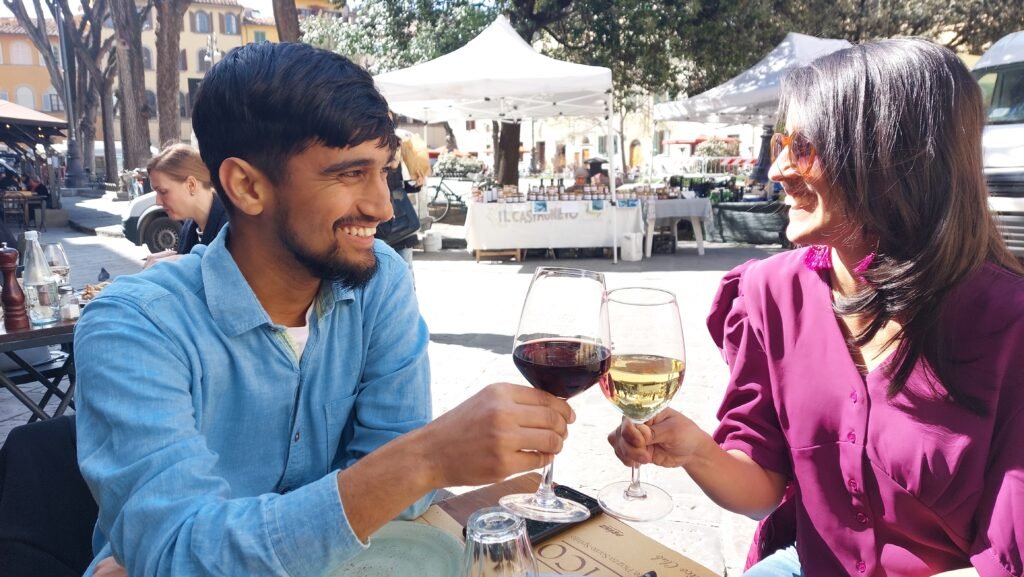
We raise our glasses to our hosts, thanking them for a weekend that is both delightfully light-hearted and deeply enriching. And then we let our mutual dreams pour out loud: of a day, sometime in our fifties, when we will sit in our own villas on the rolling Tuscan hills beyond the Florentine skyline, sipping our prized Italian coffees and looking back at this very view.
Perhaps that is the special thing about Florence. It doesn’t just light up your night. It leaves you dreaming about the life you could have here.
Is Florence on your radar too?

Leave a Reply