Marrakesh
Marrakech takes its name from the Amazigh words amur (“land”) and akush (“God”), that can be translated as “Land of God.” Nestled at the foothills of the Atlas Mountains, the city sits at a striking intersection of landscapes: the mountains rise to the south, while the vast Sahara stretches beyond them and the boundless North Atlantic Ocean flows to its west. Its ochre-coloured walls, palm-lined streets and labyrinthine souks have made Marrakech one of Morocco’s most recognisable cities—but to experience it only through the familiar language of exoticism is to miss much of what makes it meaningful.
Marrakech is not just a scenic destination; it is a city shaped by many tribes and centuries of trade and migration by the Amazigh, Arabs and other civilisations from Africa. To encounter Marrakech in a conscious way, a traveller must therefore look beyond the picture-perfect frames and notice the underlying history of imperialism, colonialism, and the complexities of its political systems that has shaped the country today.
Coming from India, Marrakech was not a cultural shock for us – something as often stated by a Westerner. Instead, we noticed so many similarities: close-knit families, multi-generational households, strong community ties, shared meals, and a general way of living that puts relationships at the heart of life.
Things to see and do in Marrakesh
- Walking tour of the Medina
- Tagine at a local restaurant
- Visit Madrassa Ben Youssef
- Stay in a locally-owned Riad
- Marvel at Bahia Palace
- Visit a Hammam
- Try Moroccan herbal teas
- Dine at a rooftop restaurant in Medina
- Visit Le Jardin Majorelle
Typical costs when traveling
Accommodation – Marrakech has a plethora of accommodations options – whether it’s a riad in the Medina or a basic hostel or hotel in the city. However, if you’re planning to stay in the Medina, be aware that it can get super noisy, even during the night time.
For a clean and basic hostel in the Medina, expect to pay around 120 – 200 Moroccan Dirhams/night
(1 EUR = 10.81 MAD) The prices for a cosy riad in the Medina starts around 550 MAD and can go upto 2000+ depending on the amenities provided. Breakfast is mostly included in the riad stays. If you stay in a hotel outside the old city, perhaps in Gueliz or Hivernage, you may find reasonable accommodation options within the range of 400 – 700 MAD per night. There are also many apartments managed by private hosts that are fully equipped with kitchen facilities, and that can sometimes help in saving some bucks for food – since you self-cater.
Food – The best part of travelling in Morocco is its FOOOOOD! We’re drooling just remembering our times savouring the varieties of Tagines in Marrakech, and elsewhere in the country. Vegans, don’t worry! We’ve got you covered. Marrakech is super vegan-friendly. And with many new eateries serving traditional dishes selectively veganised or vegetarianised, we’ve got hell lot of options that aren’t heavy on the pocket. A tagine at a working-class restaurant might cost anywhere between 40 – 80 MAD, whereas in upscale cafés and rooftop restaurants in Djemma-el-fnaa, the prices might go up to 130 – 300 MAD.
Transportation – It’s genuinely sad that not many people speak of Marrakech’s well-connected bus network! The local buses are (mostly) on time and are pretty reasonable. There’s also the option to car-pool and share Taxis. Then why do we need to rent private cars and unnecessarily contribute to the growing greenhouse gas emissions + increase our carbon footprint while exploring this incredibly gorgeous destination? “Travel LIKE a local” can also mean moving around LIKE A LOCAL!
Once you get down at the Menara airport, you can take the Alsa bus, which runs every half an hour, and starts from right outside the airport. the ticket for one-way journey costs 30 MAD. You can also pay in euros to the driver. It costs ~3 EUR. For getting around in the city, from one district to another, check out local buses from ALSA. One-way tickets costs 4 MAD.
For getting around the region, there are options of buses and trains serving major cities. However, the buses remain the most economical means of transport. A single journey from Marrakech to Merzouga (town in the Sahara desert) might cost you 450 MAD. Check out Supratours and CTM buses to travel to cities and regions outside Marrakech. Be aware of some scammy websites selling bus tickets – always good to buy tickets at the official bus station. CTM and Supratours bus stations are located in Gueliz, very close to each other.
Do’s and dont's
Here’s a mix of practical tips, local etiquettes, and a few things that’ll help you get acquainted to the city’s pace and life. Some are non-negotiable so please read carefully:
Do’s
- Do dress modestly, especially around religious sites and traditional neighbourhoods.
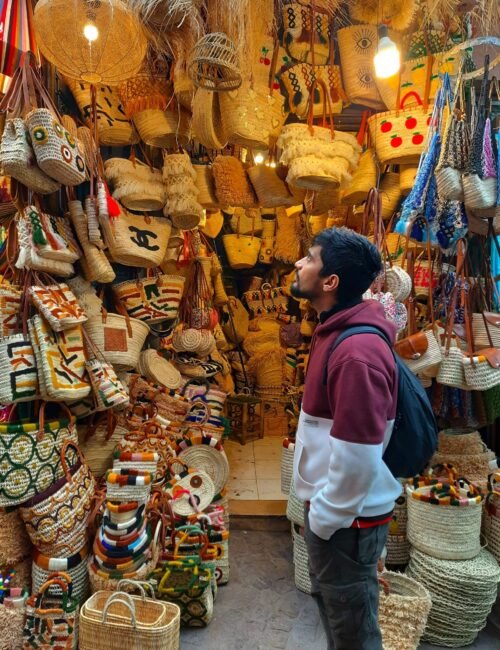
- Do bargain in Marrakech’s souks. Sometimes, the prices they ask are quite high. But keeping that in mind, please give them the necessary support to continue their small business.
- Do carry cash - it's needed almost everywhere.
- Do learn a few French/arabic words to greet them and thank them.
- Do try local buses, local dishes, local experiences.
Dont’s
- Don't support animal exploitation. This happens everywhere in Morocco - snakes, monkeys, camels are exploited for some petty cash from tourists 🙁
- Don't accept unsolicited guides offering to show you around - they can ask for a heavy sum. Only go with official tour guides.
- Don’t take pictures of the informal musicians in Jemaa el-Fnaa. They may expect a hefty payment for photos — it’s often better to simply enjoy the show.
- Please don't click pictures of locals WITHOUT taking their permission. The locals in Medina are especially fed up of foreigners hanging around in their residential neighbourhoods armed with cameras. They can get really furious if seen photographing them.
- Don't flat expensive jewellery, phones, or large amounts of cash in public.
- Don't limit yourself to tourist hotspots. Go beyond the usual trail.
- Don't forget to check taxi prices online, if the meter isn't being used.
Leave a Reply